
5800 students unlocked their dream jobs with UG/PG programs in top colleges. Apply Now!
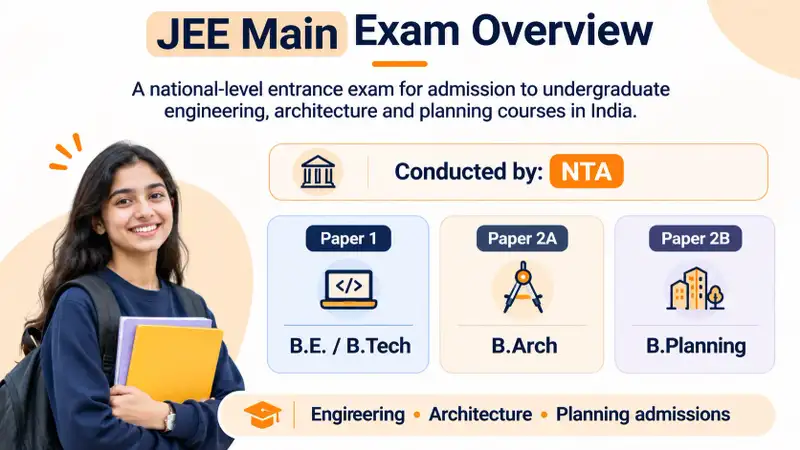
JEE Main (Joint Entrance Examination – Main) is a national-level entrance exam conducted by the National Testing Agency (NTA) for admission to undergraduate engineering, architecture and planning courses in India. It is used for admission to participating institutions such as NITs, IIITs and other technical colleges. JEE Main also serves as the qualifying examination for JEE Advanced, which is the entrance exam for IIT admission, subject to the applicable eligibility criteria. The exam includes Paper 1 for B.E./B.Tech, Paper 2A for B.Arch and Paper 2B for B.Planning.
JEE Main: Quick Overview
| Particulars | Details |
|---|---|
| Full form | Joint Entrance Examination – Main |
| Conducting body | National Testing Agency (NTA) |
| Exam level | National level |
| Exam mode | Computer-based test for applicable papers |
| Main courses | B.E., B.Tech, B.Arch and B.Planning |
| Subjects for B.E./B.Tech | Physics, Chemistry and Mathematics |
| Admission institutions | NITs, IIITs, GFTIs and other participating colleges |
| Purpose | Undergraduate admission and JEE Advanced qualification |
| Exam sessions | Generally conducted in multiple sessions during the year |
What Is JEE Main?
JEE Main stands for Joint Entrance Examination – Main. It is an entrance examination conducted by the National Testing Agency for students seeking admission to undergraduate technical courses in India.
Students primarily take JEE Main to pursue engineering degrees such as Bachelor of Engineering (B.E.) and Bachelor of Technology (B.Tech). The examination also includes papers for Bachelor of Architecture (B.Arch) and Bachelor of Planning (B.Planning).
JEE Main scores are accepted by several institutions, including:
- National Institutes of Technology (NITs)
- Indian Institutes of Information Technology (IIITs)
- Government-funded technical institutions (GFTIs)
- State-level engineering colleges
- Private engineering colleges that accept JEE Main scores
JEE Main also acts as the qualifying examination for JEE Advanced. Candidates who meet the eligibility and shortlisting criteria can appear for JEE Advanced, which is used for admission to the Indian Institutes of Technology (IITs).
In simple terms, JEE Main is an entrance exam that helps students pursue undergraduate engineering, architecture and planning programmes at participating institutions across India.
Why Is JEE Main Important?
JEE Main is important because it provides students with an opportunity to compete for admission to several engineering and technical institutions. It also serves as the qualifying stage for students aiming to appear for JEE Advanced.
Admission to NITs, IIITs and GFTIs
JEE Main scores are used for admission to participating National Institutes of Technology, Indian Institutes of Information Technology and Government-funded Technical Institutions.
Candidates compete for seats based on their rank, category, course and institute preferences, seat availability, and applicable admission rules.
Eligibility for JEE Advanced
JEE Main acts as the qualifying examination for JEE Advanced. Candidates who meet the prescribed eligibility conditions and shortlisting requirements can register for JEE Advanced.
JEE Advanced is the entrance examination used for undergraduate admission to the Indian Institutes of Technology (IITs).
Admission to State and Private Engineering Colleges
Many state-level institutions and private universities accept JEE Main scores as part of their admission process. However, admission requirements vary from college to college.
Students should check whether their preferred college accepts JEE Main scores, whether separate counselling is required, and what academic eligibility criteria they must meet.
Which Courses Can You Pursue Through JEE Main?
JEE Main includes three papers for different undergraduate programmes: B.E./B.Tech, B.Arch and B.Planning. Candidates should select the paper based on the course they want to pursue.
| Paper | Course | Main subjects or components |
|---|---|---|
| Paper 1 | B.E./B.Tech | Physics, Chemistry and Mathematics |
| Paper 2A | B.Arch | Mathematics, Aptitude and Drawing |
| Paper 2B | B.Planning | Mathematics, Aptitude and Planning |
B.E. and B.Tech Courses
Paper 1 is for students seeking admission to Bachelor of Engineering (B.E.) and Bachelor of Technology (B.Tech) programmes.
It tests candidates in Physics, Chemistry and Mathematics. These subjects form the academic foundation of engineering and are used to assess a student's conceptual understanding, analytical ability and problem-solving skills.
B.E. and B.Tech programmes offer opportunities to specialise in fields such as computer science, mechanical engineering, electrical engineering, civil engineering and other engineering disciplines, depending on the institution.
Bachelor of Architecture (B.Arch)
Paper 2A is designed for candidates interested in pursuing a Bachelor of Architecture degree.
The examination includes Mathematics, an Aptitude Test and a Drawing Test. These components assess mathematical ability, reasoning, spatial understanding and drawing skills relevant to architecture.
Candidates should also check the specific admission requirements of the architecture colleges they want to apply to.
Bachelor of Planning (B.Planning)
Paper 2B is for students seeking admission to Bachelor of Planning programmes.
The paper includes Mathematics, an Aptitude Test and planning-related questions. It evaluates the candidate's quantitative understanding, reasoning and awareness of concepts relevant to planning studies.
What Is the Difference Between JEE Main and JEE Advanced?
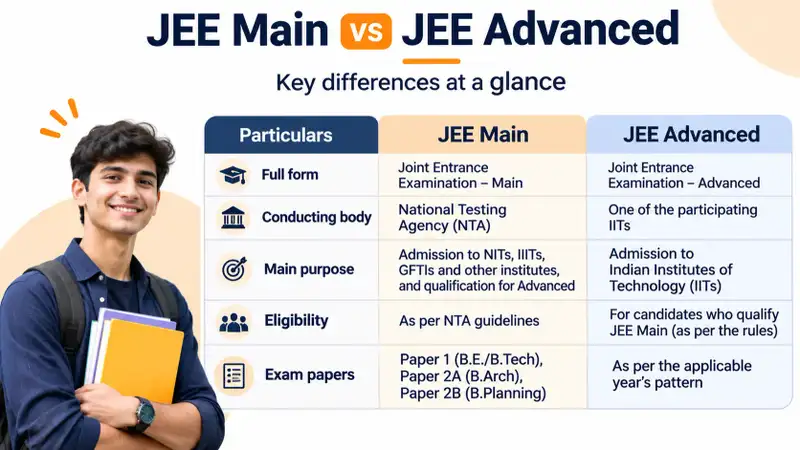
JEE Main and JEE Advanced are two different examinations in India's engineering admission process. JEE Main is used for admission to participating NITs, IIITs, GFTIs and other colleges. It also serves as the qualifying examination for JEE Advanced.
JEE Advanced is used for admission to undergraduate programmes at IITs.
| Comparison | JEE Main | JEE Advanced |
|---|---|---|
| Full form | Joint Entrance Examination – Main | Joint Entrance Examination – Advanced |
| Conducting authority | National Testing Agency (NTA) | An IIT designated for the examination |
| Main purpose | Admission to participating institutions and qualification for Advanced | Admission to IITs |
| Major institutions | NITs, IIITs, GFTIs and other participating colleges | Indian Institutes of Technology |
| Candidate eligibility | Based on JEE Main rules | Based on JEE Advanced eligibility rules |
| Exam structure | Papers for B.E./B.Tech, B.Arch and B.Planning | Pattern specified for the relevant examination year |
| Competition | Open to eligible candidates under applicable rules | Restricted to candidates who meet Advanced eligibility requirements |
The main difference: JEE Main opens admission opportunities at several participating engineering institutions and qualifies eligible candidates for JEE Advanced. JEE Advanced is the examination used for IIT undergraduate admissions.
What Is the JEE Main Exam Pattern?
The JEE Main exam pattern depends on the paper selected by the candidate. Paper 1 is for B.E./B.Tech, Paper 2A is for B.Arch and Paper 2B is for B.Planning.
The examination is conducted in computer-based mode, with the drawing component of B.Arch following the prescribed format for the applicable examination year.
JEE Main Paper 1 for B.E./B.Tech
Paper 1 tests candidates in three subjects:
- Physics
- Chemistry
- Mathematics
The question paper includes objective-type questions and numerical-value questions as specified in the applicable exam pattern.
| Subject | What it tests |
|---|---|
| Physics | Concepts, principles, applications and numerical problem-solving |
| Chemistry | Chemical concepts, reactions and applications |
| Mathematics | Mathematical concepts, calculations and analytical problem-solving |
Candidates should check the latest NTA information bulletin for the exact number of questions, marks, duration, section structure and marking scheme.
JEE Main Paper 2A for B.Arch
Paper 2A is designed for candidates applying to Bachelor of Architecture programmes.
It includes:
- Mathematics
- Aptitude Test
- Drawing Test
The Mathematics section evaluates quantitative understanding. The Aptitude Test assesses relevant reasoning and spatial abilities. The Drawing Test measures drawing and visualisation skills according to the prescribed exam requirements.
JEE Main Paper 2B for B.Planning
Paper 2B is intended for candidates applying to Bachelor of Planning programmes.
It includes:
- Mathematics
- Aptitude Test
- Planning-based questions
Candidates interested in urban planning and related fields should review the official Paper 2B syllabus to understand the topics and question formats.
Who Is Eligible for JEE Main?
JEE Main eligibility depends on the candidate's qualifying examination, subjects, Class 12 passing year and the rules specified for the relevant exam year.
Students should distinguish between eligibility to appear for JEE Main and eligibility for admission to a particular college or programme. These criteria may be different.
Educational Qualification for JEE Main
Candidates who have passed or are appearing for Class 12 or an equivalent qualifying examination may be eligible, subject to the examination-year rules.
The required subject combination depends on the course and paper selected. For B.E./B.Tech programmes, Physics and Mathematics are key subjects, along with other prescribed subject requirements.
B.Arch and B.Planning applicants should check the specific subject combinations and qualifying examination conditions applicable to their chosen programme.
For detailed criteria, read the JEE Main eligibility requirements.
JEE Main Age Limit
Candidates should check the age-related eligibility conditions specified in the official information bulletin for the relevant examination year.
The eligibility conditions for appearing in JEE Main may differ from the admission requirements of individual institutions. Students should verify both before applying.
Number of Attempts for JEE Main
The permitted examination years and attempt conditions are defined by the National Testing Agency for each examination cycle.
Candidates should check the current notification to confirm which Class 12 passing years are eligible and how the attempt window applies to them.
Class 12 Marks Requirements for College Admission
The minimum marks required to appear for JEE Main and the academic marks required for admission to a particular institution are not necessarily the same.
Admission to NITs, IIITs and other institutions may involve additional Class 12 performance conditions, such as a specified aggregate percentage or a board-wise top percentile criterion, depending on the applicable rules.
Students should verify the current requirements for their preferred institutions before participating in counselling.
How Does the JEE Main Admission Process Work?
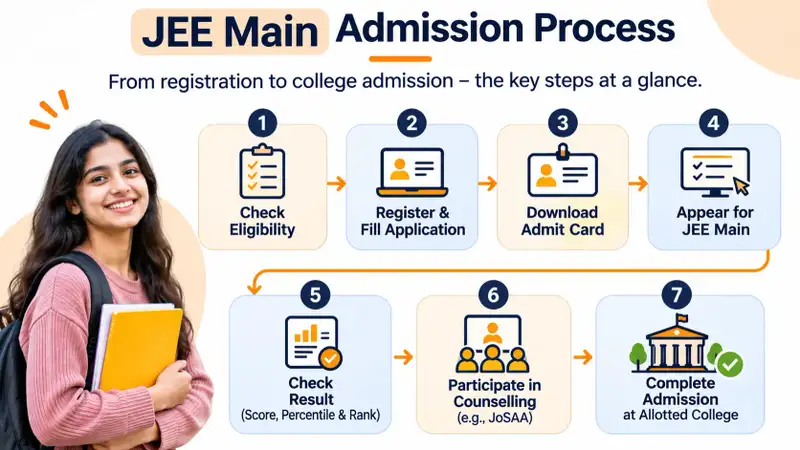
The JEE Main admission process generally involves registration, appearing for the examination, checking the result and participating in the relevant counselling or admission process.
The usual steps are:
- Check eligibility: Review the examination and course-specific requirements.
- Complete registration: Fill out the application form through the official NTA portal.
- Select the paper: Choose the paper based on the course you want to pursue.
- Download the admit card: Follow the instructions issued by the NTA.
- Appear for JEE Main: Take the selected examination.
- Check your result: Review your score, percentile and rank when released.
- Participate in counselling: Apply through the relevant counselling or institutional admission process.
- Complete admission formalities: Follow the instructions of the allotted institution.
Registration and Application
Candidates must complete the online application process within the dates announced by the NTA.
The registration process generally includes entering personal information, academic details, uploading required documents, selecting the examination paper and paying the applicable fee.
Follow the JEE Main registration and application guide for a detailed explanation of the application process.
Appearing for the Examination
After completing registration, candidates should download their admit cards and follow the examination-day instructions.
The exam date, shift, reporting time, centre details and permitted items are communicated through official NTA notices and candidate documents.
Candidates can refer to the JEE Main exam date and schedule guide for schedule-related information.
Understanding JEE Main Score, Rank and Percentile
JEE Main results provide performance information that candidates use during the admission process. Marks, percentile and rank have different meanings.
- Marks: The score calculated from a candidate's responses under the exam marking scheme.
- Percentile: A normalised measure of performance relative to other candidates.
- Rank: A candidate's position in the applicable merit list.
A higher percentile generally indicates stronger relative performance. However, the relationship between marks, percentile and rank can vary depending on session performance, paper difficulty and the number of candidates.
Read the detailed explanation of JEE Main marks, percentile and rank.
JoSAA Counselling and Seat Allotment
The Joint Seat Allocation Authority (JoSAA) manages the centralised seat-allocation process for participating IITs, NITs, IIITs and other institutions covered by its counselling system.
Candidates participate in counselling by selecting their preferred institutes and programmes, subject to eligibility and seat availability.
Seat allotment can depend on:
- JEE Main or JEE Advanced rank, as applicable
- Candidate category
- Institute and course preferences
- Available seats
- Admission and reservation rules
Not every college that accepts JEE Main scores participates in JoSAA. Some colleges and universities conduct separate admission processes.
When Is JEE Main Conducted?
JEE Main is generally conducted in multiple sessions during the year. In recent examination cycles, the sessions have typically been held around January and April.
The NTA announces the examination calendar, registration dates, application deadlines, admit card availability and result schedules through official notifications.
Candidates should check the current examination calendar rather than relying on dates from previous years because the schedule may change.
What Subjects Are Included in JEE Main?
The subjects included in JEE Main depend on the paper selected by the candidate.
Paper 1 for B.E./B.Tech includes Physics, Chemistry and Mathematics. Paper 2A and Paper 2B include Mathematics and Aptitude, along with Drawing or Planning components, respectively.
Physics
Physics tests candidates on concepts, scientific principles, calculations and their applications.
Preparation generally involves understanding concepts, learning relevant formulas, solving numerical problems and practising application-based questions.
Chemistry
Chemistry covers concepts related to physical, organic and inorganic chemistry.
Candidates need to understand chemical principles, reactions, structures and relevant calculations. Regular practice and revision help improve conceptual clarity and retention.
Mathematics
Mathematics evaluates logical reasoning, calculation skills and the ability to solve problems using mathematical concepts.
Candidates should practise questions regularly and develop accuracy across the topics included in the applicable syllabus.
For detailed subject-wise topics, refer to the complete JEE Main syllabus.
How Should You Start Preparing for JEE Main?
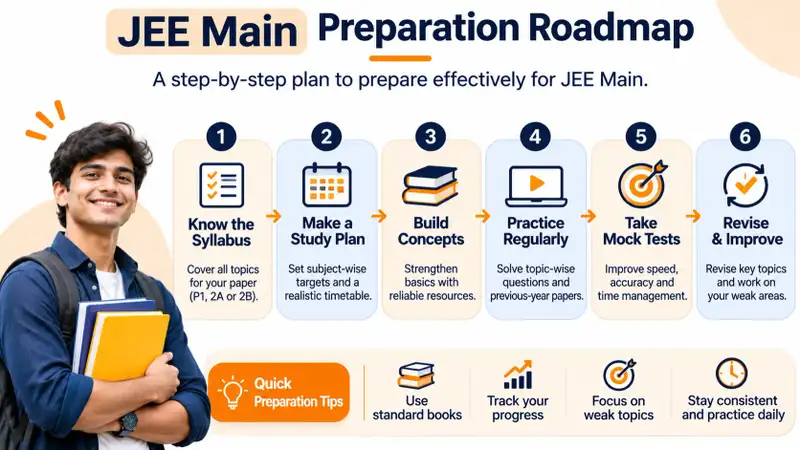
Students preparing for JEE Main should begin by understanding the syllabus, identifying their strengths and weaknesses, and creating a realistic study plan.
A consistent preparation routine helps candidates cover the required subjects, strengthen concepts and improve problem-solving skills.
Understand the JEE Main Syllabus
Start by reviewing the official syllabus for the paper you plan to take.
Identify the topics included in Physics, Chemistry and Mathematics for Paper 1, or the relevant components for Paper 2A and Paper 2B.
Avoid relying on an old syllabus without checking the latest examination information.
Create a Subject-Wise Study Plan
Divide your preparation time across the subjects and topics included in the examination.
A practical study plan can include:
- Learning new concepts
- Solving topic-wise questions
- Revising previously covered chapters
- Practising numerical problems
- Taking mock tests
Set weekly targets and review your progress regularly to identify areas that need improvement.
Practice Questions and Mock Tests
Solving practice questions helps students understand how concepts are tested in the examination.
Mock tests can help candidates assess their preparation, manage time, improve accuracy and identify topics that need more attention.
Revise Concepts and Analyse Mistakes
Revision is an important part of JEE Main preparation.
After completing a practice test, review incorrect answers and identify whether the problem was caused by a conceptual gap, calculation error, misunderstanding or time-management issue.
For a more detailed preparation plan, read Sunstone's JEE Main preparation strategy and tips.
What Is the Difference Between JEE Main Marks, Percentile and Rank?
Marks, percentile and rank are three different measures used to understand a candidate's performance in JEE Main.
| Term | Meaning |
|---|---|
| Marks | Score obtained based on responses and the marking scheme |
| Percentile | Relative performance compared with other candidates |
| Rank | Position assigned in the applicable merit list |
A candidate's marks do not translate into a fixed percentile or rank in every examination session. The relationship can change depending on factors such as paper difficulty, session-wise performance and the number of candidates.
Students should use the official result and merit-list information when evaluating their performance.
For a detailed comparison, read the JEE Main marks, rank and percentile guide.
Frequently Asked Questions
What is JEE Main used for?
JEE Main is used for admission to undergraduate engineering, architecture and planning programmes at participating institutions. It also serves as the qualifying examination for JEE Advanced, subject to the applicable eligibility and shortlisting rules.
Is JEE Main compulsory for engineering?
JEE Main is required for admission to institutions and programmes that use its scores as an entrance criterion. However, not every engineering college in India uses JEE Main. Some institutions accept other entrance examinations or conduct their own admission process.
Can Class 11 students appear for JEE Main?
Class 11 students can begin preparing for JEE Main, but appearing for the examination depends on the qualifying examination and passing-year conditions specified by the NTA. Students should check the current eligibility bulletin before applying.
Can I take JEE Main after Class 12?
Yes, candidates who have passed Class 12 may be eligible to appear for JEE Main within the permitted examination-year window. The applicable passing-year and attempt conditions should be checked in the current NTA notification.
How many times is JEE Main conducted in a year?
JEE Main has generally been conducted in multiple sessions each year, commonly around January and April in recent cycles. Candidates should check the official NTA calendar for the current examination year.
Is JEE Main required for NIT admission?
Yes, JEE Main scores are used for admission to NITs. Candidates must also satisfy the applicable academic eligibility conditions and participate in the relevant counselling process.
Is JEE Main required for IIT admission?
Candidates must qualify through JEE Main to become eligible for JEE Advanced, subject to the applicable rules. Admission to IIT undergraduate programmes is based on JEE Advanced performance and the prescribed admission criteria.
Is JEE Main difficult?
JEE Main is a competitive entrance examination that tests conceptual understanding, application and problem-solving skills. Its difficulty can vary across sessions and subjects. Preparation, practice and time management are important for performing well.
Which subjects are required for JEE Main B.Tech?
JEE Main Paper 1 for B.E./B.Tech tests Physics, Chemistry and Mathematics. Candidates should also check the qualifying examination subject requirements for admission to their preferred institutions.
Can I get admission to a private engineering college through JEE Main?
Yes, some private engineering colleges accept JEE Main scores for admission. Their admission criteria, accepted examinations, seat availability and counselling processes vary. Candidates should confirm the requirements directly with the institution.
Can I appear for JEE Main without coaching?
Yes, candidates can prepare for JEE Main without joining a coaching institute. They can use the official syllabus, textbooks, practice questions, previous-year papers and mock tests to organise their preparation.
What is the full form of JEE Main?
JEE Main stands for Joint Entrance Examination – Main. It is a national-level entrance examination conducted by the National Testing Agency for admission to participating undergraduate technical programmes in India.
Note: JEE Main eligibility, examination pattern, dates, marking scheme and admission rules may change between examination cycles. Candidates should always refer to the latest NTA information bulletin and the admission rules of the institution they are applying to.
HELP
Take the first step towards your dream job.
ABOUT THE AUTHOR