%20(1)_20220516165429_0.png&w=256&q=75&dpl=dpl_8Rbmh2PVrxiB7dTvGeyF7C1ayLE5)

5800 students unlocked their dream jobs with UG/PG programs in top colleges. Apply Now!
MBA full form is Master of Business Administration — a two-year postgraduate degree that trains students in business management, leadership, finance, marketing, operations, and strategy. MBA is one of the most widely pursued management qualifications in India, with over 3.5 lakh seats across AICTE-approved institutions as of 2024.
This guide explains what an MBA is, who should pursue it, what it covers, how admissions work, what it costs, and what career and salary outcomes you can realistically expect.
What Is MBA? Full Form, Meaning and Overview
MBA stands for Master of Business Administration. It is a postgraduate degree that focuses on business management, leadership, and organisational decision-making. Unlike specialised degrees that focus on one subject, an MBA provides a broad understanding of how businesses function as a whole.
An MBA programme covers core business areas including marketing, finance, human resources, operations, economics, and strategy. The goal is to help students understand how these functions work together within an organisation and how managerial decisions drive business outcomes.
In India, a full-time MBA is a two-year programme divided into four semesters. Students study core subjects in the first year and choose a specialisation in the second year based on their career interests. MBA programmes are offered by universities, IIMs, government institutions, and private colleges under regulatory norms set by UGC and AICTE.
Why Choose an MBA? Key Benefits
- Career advancement: Prepares candidates for managerial and leadership roles rather than entry-level positions
- Skill development: Builds analytical thinking, communication, leadership, and problem-solving skills
- Career flexibility: MBA graduates move across industries — finance, marketing, consulting, operations, technology, healthcare
- Professional network: Brings together students from different academic and professional backgrounds, creating long-term networking value
- Higher salary trajectory: MBA starting salary for freshers in India ranges from ₹6–12 LPA at mid-tier colleges and ₹20–35 LPA at IIMs
MBA Eligibility Criteria
Educational Qualification and Minimum Marks
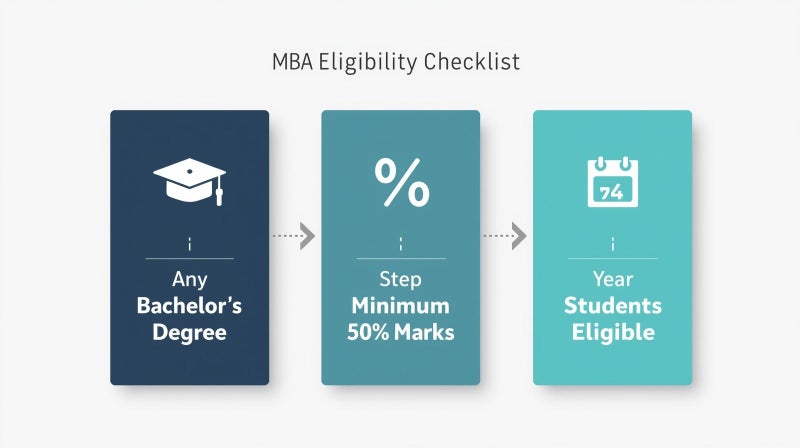
To be eligible for an MBA in India, candidates must generally meet the following conditions:
- A Bachelor's degree in any discipline from a recognised university
- Minimum aggregate marks of 50% for General category candidates
- Relaxation to 45% for SC/ST/OBC candidates, as per applicable norms
- Final-year graduation students are allowed to apply, provided they complete the degree before enrollment
Eligibility conditions vary across institutions. Always check the official admission notification of the specific college before applying.
Age Limit, Work Experience and Reservation
- No official upper age limit for most regular MBA programmes
- Work experience is not mandatory for full-time MBA; Executive MBA programmes typically require 3–5 years
- Reservation policies for SC, ST, OBC, EWS, and PwD candidates are followed as per government guidelines
MBA After Different Graduation Backgrounds
MBA is open to graduates from all academic streams. Engineering, commerce, arts, science, and medical graduates are all eligible. Different backgrounds bring different strengths to the classroom and the placement process.
| Graduation Background | Is MBA Possible? | Best-Fit Specialisations | Typical Career Outcome |
| B.Tech / B.E. | Yes — preferred at many B-schools | Finance, Business Analytics, IT Management | MBA after BTech — scope and salary |
| B.Com / BBA | Yes — strong eligibility fit | Finance, Marketing, Banking & Finance | MBA after BCom — career scope |
| BA (Arts) | Yes — eligible | HR, Marketing, International Business | HR Manager, PR Consultant, Development Manager |
| B.Sc (Science) | Yes — eligible | Business Analytics, Healthcare Management | Analytics Consultant, Hospital Administrator |
| MBBS | Yes — eligible | MBA in Healthcare Management | Hospital Admin, Pharma Operations |
Engineers make up approximately 60–70% of MBA cohorts at top IIMs. Commerce and arts graduates consistently perform well in marketing, HR, and international business roles.
MBA Entrance Exams
National and State-Level MBA Entrance Exams
MBA admission in India is primarily based on entrance examinations that assess quantitative ability, verbal ability, logical reasoning, and data interpretation.
| Exam | Full Form | Conducted By | Accepted By |
| CAT | Common Admission Test | IIMs | IIMs, 1,200+ colleges |
| XAT | Xavier Aptitude Test | XLRI | XLRI, 1,000+ colleges |
| CMAT | Common Management Admission Test | NTA | AICTE-approved institutes |
| MAT | Management Aptitude Test | AIMA | 600+ colleges |
| NMAT | NMIMS Management Aptitude Test | GMAC | NMIMS and partners |
| SNAP | Symbiosis National Aptitude Test | Symbiosis | All Symbiosis institutes |
| ATMA | AIMS Test for Management Admissions | AIMS | 500+ colleges |
| MAH CET | Maharashtra Common Entrance Test | State CET Cell | Maharashtra colleges |
MBA Without Entrance Exams
Some private universities offer MBA admission without national-level entrance exams. Such admissions may be based on graduation marks, institutional aptitude tests, or management quota seats. Always verify that the programme is AICTE-approved before enrolling, as recognition directly affects degree validity.
MBA Syllabus in India
A full-time MBA is a two-year, four-semester programme. See the complete MBA subjects and syllabus in India for semester-wise details.
| Semester 1 | Semester 2 | Semester 3 | Semester 4 |
| Corporate Social Responsibility | Macroeconomics | Supply Chain Management | Internship Projects |
| Microeconomics | Business Law | Financial Modelling | Specialisation electives |
| Principles of Marketing Management | Operations Management | Strategic Management | Live projects |
| Principles of Accounting | Corporate Finance | Business Intelligence | Dissertation (some colleges) |
| Quantitative Methods & Statistics | Project Management | Marketing Research | |
| Business Communication | Marketing Management | Managerial Economics | |
| Organisational Behaviour 1 | Organisational Behaviour 2 | Corporate Governance & Ethics |
Semester 4 is primarily the industry internship and specialisation project. Core curriculum may vary by institution.
Types of MBA
Full-Time, Part-Time and Executive MBA
- Full-Time MBA: Regular on-campus programme, typically two years. Ideal for fresh graduates and early-career professionals. Most campus placements happen through this route
- Part-Time MBA: Designed for working professionals. Usually evening or weekend classes alongside employment
- Executive MBA (EMBA): Targeted at professionals with 5+ years of experience. Focuses on strategic and executive-level learning. See what is an Executive MBA
Know more about full-time MBA vs online MBA comparison.
Online, Distance and Integrated MBA
- Online MBA: Delivered digitally. Suited for professionals who need flexibility. Recognition depends on UGC/AICTE approval — always verify before enrolling. See full-time MBA vs online MBA comparison
- Distance MBA: Self-paced learning with limited campus interaction
- Integrated MBA: A five-year BBA + MBA combined programme offered by select universities to students entering after Class 12
MBA vs PGDM — What Is the Difference?
One of the most common questions from MBA aspirants is whether PGDM and MBA are the same. The short answer: yes, for most practical purposes. The difference between PGDM and MBA lies in the regulatory body, not in career outcomes.
| Parameter | MBA | PGDM |
| Full Form | Master of Business Administration | Post Graduate Diploma in Management |
| Awarded By | Universities (UGC-regulated) | Autonomous institutes (AICTE-approved) |
| Who Gives It | FMS Delhi, Jamia, BHU, state colleges | All IIMs, XLRI, SPJIMR, MDI, NMIMS |
| Type | Degree | Diploma |
| Curriculum | Follows university schedule | Can be updated annually to match industry |
| Employer View | Fully accepted | Treated as equivalent by most employers |
| Duration | 2 years | 2 years (some 1-year options) |
All IIMs award PGDM, not MBA. When someone says they are an 'IIM graduate with an MBA', they technically hold a PGDM. The two terms are widely used interchangeably in India.
MBA Specialisations — Full List with Salary and Career Roles
MBA specialisations determine the business function you will work in post-degree. Choosing the right MBA specialisation is one of the most important decisions you will make during the programme.
| Specialisation | Average Starting Salary (2025) | Top Career Roles | Top Hiring Sectors |
| Finance | ₹12–25 LPA | Financial Analyst, Investment Banker, CFO track | BFSI, Private Equity, Consulting |
| Marketing | ₹8–18 LPA | Brand Manager, Digital Marketing Manager, Sales Head | FMCG, E-commerce, Media |
| Human Resource Management | ₹6–14 LPA | HR Business Partner, Talent Acquisition Lead | IT, Manufacturing, Consulting |
| Operations & Supply Chain | ₹8–16 LPA | Supply Chain Manager, Logistics Head, Ops Manager | Manufacturing, Retail, E-commerce |
| Business Analytics | ₹10–22 LPA | Data Analyst, BI Manager, Analytics Consultant | IT, Fintech, Startups |
| IT & Systems | ₹10–20 LPA | Product Manager, IT Consultant, Systems Analyst | IT Services, Tech Consulting |
| International Business | ₹8–16 LPA | Export Manager, Trade Analyst, Global Ops Head | MNCs, Export Firms, Consulting |
| Healthcare Management | ₹7–14 LPA | Hospital Administrator, Pharma Operations Manager | Pharma, Healthcare, Hospitals |
| Digital Marketing | ₹8–16 LPA | SEO/SEM Manager, Content Strategist, Growth Hacker | E-commerce, Agencies, SaaS |
| Banking & Finance | ₹9–18 LPA | Relationship Manager, Credit Analyst, Treasury Officer | Banks, NBFCs, Insurance |
| Entrepreneurship | Variable | Founder, Business Development Head, Venture Analyst | Startups, VC Firms, Family Business |
Salary data sourced from NIRF placement reports 2024–25. Actual packages depend on college reputation and individual performance.
Finance, Business Analytics, and Consulting-track roles consistently offer the highest paying MBA specialisations in India. Marketing and HR see the widest hiring volume.
MBA Dual Specialisation
Some MBA programmes allow students to pursue two specialisations simultaneously — for example, Finance + Business Analytics, or Marketing + International Business. Dual specialisation in MBA improves placement outcomes for cross-functional roles, particularly in fintech, digital strategy, and global operations.
MBA Admission Process
Step-by-Step MBA Admission Process
The MBA admission process in India follows a structured sequence across most B-schools:
- Step 1: Register and appear for an MBA entrance exam (CAT, XAT, CMAT, MAT, or others)
- Step 2: Apply to colleges using entrance exam scores
- Step 3: Receive shortlist calls based on cut-off criteria
- Step 4: Participate in further evaluation rounds — GD, PI, WAT
GD, PI and Written Ability Test (WAT)
After exam shortlisting, most institutes conduct evaluation rounds. For detailed MBA GD PI preparation tips:
- Group Discussion (GD): Assesses communication skills, group dynamics, and logical argumentation
- Personal Interview (PI): Evaluates motivation, clarity of career goals, and personality fit
- Written Ability Test (WAT): Tests writing clarity, analytical thinking, and language skills
MBA Fees Structure
MBA Fees in Government vs Private Colleges
MBA fees in India vary widely depending on the type and tier of institution. Fees are generally charged annually or semester-wise.
| Parameter | Government MBA Colleges | Private MBA Colleges |
| Typical Fee (2 Years) | ₹50,000 – ₹3 lakh (top govt institutes higher) | ₹4 lakh – ₹20 lakh+ |
| Top Institute Fee | IIMs / IIT MBA: ₹15–28 lakh | Top private B-schools: ₹12–30 lakh |
| Examples | FMS Delhi, BHU, Jamia, IIMs | XLRI, SPJIMR, NMIMS, Symbiosis, Amity |
| Fee Subsidy | Yes (central or state government) | No subsidy — self-financed |
| ROI | Generally high due to low fees | Depends heavily on placements |
| Entrance Requirement | Mostly mandatory (CAT, CMAT, state CETs) | Often required; some allow direct admission |
| Seat Availability | Limited and highly competitive | Larger intake capacity |
| Placement Support | Strong in top govt colleges | Varies by institute reputation |
Scholarships, Education Loans and ROI
To manage the MBA course fees and duration, students can explore:
- Scholarships for MBA students — government and institutional merit-based aid
- Education loan for MBA in India — nationalised and private bank loans
- Financial aid based on economic background, available at several AICTE-approved colleges
Top MBA Colleges in India
Top Government and IIM MBA Colleges
| Institute | Location | Admission Exam | Key Strength |
| FMS Delhi | Delhi | CAT | Extremely low fees, very high ROI |
| IIM Ahmedabad | Ahmedabad | CAT | Finance, consulting, strategy |
| IIM Bangalore | Bangalore | CAT | Entrepreneurship, technology |
| IIM Calcutta | Kolkata | CAT | Finance, investment banking |
| SJMSOM — IIT Bombay | Mumbai | CAT | Tech + management integration |
| DMS — IIT Delhi | Delhi | CAT | Consulting, data, strategy |
| BHU – IMS | Varanasi | CAT | Public university, strong academics |
| Jamia Millia Islamia | Delhi | JMI / CAT | Very affordable MBA programme |
Top Private MBA Colleges and Rankings
| Private MBA College | Location | NIRF 2025 Rank | Key Reputation Area |
| MDI Gurgaon | Gurgaon | 9 | Consulting, marketing, strong alumni |
| XLRI Jamshedpur | Jamshedpur | 10 | HR, leadership, ethics, general management |
| SIBM Pune | Pune | 11 | Marketing, operations, brand value |
| SPJIMR Mumbai | Mumbai | 20 | Strategy, finance, experiential learning |
| NMIMS Mumbai | Mumbai | 24 | Finance, marketing, large corporate network |
| IMT Ghaziabad | Ghaziabad | 30 | Marketing, BFSI, consulting |
| MICA Ahmedabad | Ahmedabad | 33 | Marketing, communications, branding |
| Great Lakes | Chennai/Gurgaon | 37 | Analytics, digital business |
For city-specific lists, explore: MBA colleges in Bangalore, MBA colleges in Pune, MBA colleges in Delhi without CAT, MBA colleges in Chennai, or see the full list of top MBA colleges in India.
MBA Salary and Placements
Average MBA Salary by Specialisation
| MBA Specialisation | Average Salary Range (LPA) | Top Hiring Sectors |
| Finance | ₹18 – ₹30 LPA | Investment Banking, BFSI, Private Equity |
| Business Analytics | ₹13 – ₹22 LPA | IT, Consulting, Startups, Fintech |
| Operations & Supply Chain | ₹10 – ₹18 LPA | Manufacturing, Logistics, E-commerce |
| Human Resources (HR) | ₹10 – ₹14 LPA | IT, Consulting, Conglomerates |
| Marketing | ₹8 – ₹18 LPA | FMCG, E-commerce, Media, Agencies |
| IT / Systems | ₹8 – ₹20 LPA | IT Services, Tech Consulting, Product |
| International Business | ₹9 – ₹16 LPA | Export Firms, MNC Operations |
Average MBA Salary by College Tier — Complete 2025 Breakdown
The MBA placement trends in India 2026 show that college tier remains the single biggest determinant of starting salary. Here is the complete picture across all tiers:
| College Tier | Examples | Avg. Package | Median | Top Package |
| IIM A/B/C + ISB | IIM Ahmedabad, IIM Bangalore, ISB | ₹28–35 LPA | ₹26 LPA | ₹60 LPA–1 Cr+ |
| Other IIMs | IIM Lucknow, Kozhikode, Indore | ₹18–25 LPA | ₹20 LPA | ₹40–60 LPA |
| Elite Private | XLRI, SPJIMR, MDI, FMS Delhi | ₹15–22 LPA | ₹16 LPA | ₹30–50 LPA |
| Strong Private | NMIMS, IMT Ghaziabad, Great Lakes | ₹10–18 LPA | ₹12 LPA | ₹22–30 LPA |
| Established Private | State-level AICTE-approved colleges | ₹6–10 LPA | ₹7 LPA | ₹12–18 LPA |
| Other Private | Lower-ranked private colleges | ₹3–6 LPA | ₹4 LPA | ₹8–12 LPA |
Source: NIRF 2025 placement disclosures, IIM placement reports 2024–25, Careers360 data. For a full breakdown by role, experience, and specialisation, see our guide on MBA starting salary for freshers in India.
MBA Career Scope
Career Opportunities and Job Roles After MBA
After completing an MBA, graduates typically move into roles such as:
- Business analyst or management consultant
- Marketing or brand manager
- Finance manager or investment analyst
- HR business partner or talent acquisition lead
- Operations or supply chain manager
- Product manager (particularly for engineering + MBA graduates)
- Entrepreneur or startup founder
For a detailed breakdown of job roles and industries, see our guide on career options after MBA and the most in-demand jobs after MBA.
Government Jobs After MBA
MBA graduates are not limited to the private sector. Government job opportunities after MBA include roles in public sector banks, PSUs, civil services (with additional exams), and management-track positions in central and state government enterprises.
Future Scope of MBA in India
According to Custom Market Insights, the global MBA education market is expected to reach USD 83.08 billion by 2032, reflecting sustained employer demand for management graduates. In India, growth is being driven by fintech, healthcare, e-commerce, and data-intensive industries — all of which need MBA-trained managers at scale.
Is an MBA Worth It in 2026?
The honest answer to whether MBA is still a golden ticket depends on four specific factors:
| Factor | When MBA Is Worth It | When MBA May Not Be Worth It |
| College quality | Strong placement record; ROI clear within 4–5 years |
Fees exceed what placements can realistically recover
|
| Career goal clarity | Clear target role (Finance → IB, Ops → SCM, Tech → PM) |
No defined goal — pursuing MBA 'just to have a degree'
|
| Specialisation demand | Finance, Analytics, Consulting — high market demand |
Declining demand niches or oversaturated roles
|
| Timing | After 1–3 years of work experience for stronger ROI |
Immediately after graduation without industry exposure
|
MBA Without Work Experience
Fresh graduates can and do pursue MBA successfully. However, candidates with work experience and MBA admissions tend to receive 15–25% higher packages at the same college and perform more confidently in GD/PI rounds due to real-world examples to draw from.
If you are a fresh graduate, MBA is still a strong path — particularly at colleges with structured internship programmes and industry-linked placements.
Common Misconceptions About MBA
Myth: MBA is only for commerce or business students.
Reality: Any graduate — engineering, arts, science, law, medicine — can pursue an MBA. Engineering graduates make up 60–70% of cohorts at top IIMs. Commerce and arts graduates perform well in marketing, HR, and international business roles.
Myth: You need 99 percentile in CAT to get into a good MBA college.
Reality: IIM A/B/C require 99%+, but hundreds of strong AICTE-approved colleges with ₹15–20 LPA average placements accept 75–85 percentile. Non-CAT options (CMAT, MAT, ATMA) open further doors.
Myth: An MBA guarantees a high salary.
Reality: College reputation, specialisation demand, internship performance, and individual effort determine salary — not the MBA degree itself. College quality is the single biggest salary driver.
Myth: PGDM is inferior to MBA because it is a diploma.
Reality: All IIMs, XLRI, SPJIMR, and MDI award PGDM, not MBA. PGDM from an AICTE-approved autonomous institute is treated as equivalent or superior to an MBA from an average university by Indian and international employers.
Myth: Online MBA and full-time MBA are equivalent for campus recruitment.
Reality: A UGC-approved online MBA has growing lateral hiring acceptance. However, campus placement — where companies actively recruit at college — is open only to full-time on-campus students.
Myth: MBA after engineering is a waste of a technical degree.
Reality: Engineering graduates with an MBA occupy the most competitive roles in India — product management, tech consulting, analytics leadership, startup founding. The combination is actively sought by McKinsey, BCG, Amazon, and Google.
Frequently Asked Questions
Q: What is MBA full form?
MBA full form is Master of Business Administration. It is a two-year postgraduate degree covering finance, marketing, human resources, operations, and strategy. It is one of the most widely pursued management qualifications in India.
Q: What is the MBA full form salary in India?
MBA salary in India ranges from ₹6–12 LPA at mid-tier colleges and ₹20–35 LPA at top institutions such as IIMs, XLRI, and SPJIMR. Salary depends primarily on college tier, specialisation, and placement performance. See our complete guide on average MBA compensation by specialisation and tier.
Q: Can I do MBA without a CAT score?
Yes. Many private colleges accept CMAT, MAT, ATMA, XAT, or NMAT in place of CAT. Some offer direct admission based on graduation marks. See our guide on MBA colleges that do not require CAT for a complete list.
Q: What is the difference between MBA and PGDM?
MBA is a degree from a university under UGC regulations. PGDM is a diploma from an AICTE-approved autonomous institute — including all IIMs. Both are treated as equivalent by most Indian employers. Read the detailed PGDM vs MBA comparison.
Q: Which MBA specialisation has the highest salary?
Finance, Business Analytics, and Consulting roles consistently offer the highest starting packages. Finance roles at top B-schools start at ₹18–25 LPA. See the full guide on highest paying MBA specialisations in India.
Q: What is the duration of an MBA in India?
A full-time MBA is 2 years (4 semesters). Some institutes offer 1-year programmes for working professionals with prior experience. Executive MBA programmes typically run 12–18 months.
Q: Is MBA a UG or PG degree?
MBA is a postgraduate (PG) degree. It requires a bachelor's degree as a prerequisite. Final-year graduation students can apply but must complete their degree before joining the programme.
Q: How many subjects are in MBA first year?
MBA first year typically covers 14–16 core subjects across semesters 1 and 2, including Organisational Behaviour, Marketing Management, Financial Accounting, Quantitative Methods, Business Law, Corporate Finance, and Operations Management. See the complete MBA first year subjects list.
Q: Is there an age limit for MBA?
No upper age limit exists for regular full-time MBA in India. Executive MBA programmes require work experience but do not impose an age ceiling.
Q: What is the full form of MBA in education?
In education, MBA stands for Master of Business Administration. It is a postgraduate degree, not an undergraduate qualification. Admission requires a completed bachelor's degree in any stream.
Q: What MBA entrance exams should I appear for?
For IIMs and top B-schools: CAT. For broader access: CMAT + MAT in addition to CAT. For state-specific colleges: MAH CET (Maharashtra), TANCET (Tamil Nadu), KMAT (Karnataka). See the complete MBA entrance exam guide.
Q: How to apply for MBA admission in India?
Register for an entrance exam → appear for the exam (Oct–Jan) → apply to colleges with scores → clear GD/PI/WAT → accept offer and enroll. For a full step-by-step guide, see how to apply for MBA admission in India.
Summary — MBA Full Form Key Facts at a Glance
| Topic | Key Information |
| MBA Full Form | Master of Business Administration |
| Type | Postgraduate (PG) degree |
| Duration | 2 years full-time (4 semesters) |
| Eligibility |
Graduation in any stream, minimum 50% marks
|
| Top Entrance Exams |
CAT, XAT, CMAT, MAT, SNAP, NMAT, ATMA, MAH CET
|
| Fees Range | ₹1 lakh (govt) to ₹28 lakh (IIMs) |
| Average Salary |
₹6–12 LPA (mid-tier); ₹20–35 LPA (IIMs + top private)
|
| Highest Paying Streams |
Finance, Business Analytics, Consulting
|
| Top Colleges |
IIM A/B/C, FMS Delhi, XLRI, SPJIMR, MDI, NMIMS
|
| MBA vs PGDM |
Treated as equivalent; IIMs award PGDM not MBA
|
| Open To |
All graduates — engineering, commerce, arts, science
|
- MBA full form is Master of Business Administration — a 2-year PG degree in business management
- Open to all graduates regardless of stream, with 50% minimum marks
- CAT is the most widely accepted exam; CMAT, MAT, and ATMA are non-CAT alternatives
- Fees range from ₹1 lakh (govt colleges) to ₹28 lakh (IIMs); loans and scholarships are available
- Salary ranges from ₹6–12 LPA at mid-tier to ₹25–35 LPA at IIMs — college quality is the biggest driver
- Finance and Business Analytics offer the highest starting packages
A Note Before You Decide
An MBA is not just a degree — it is a career-shaping investment. Before enrolling, carefully evaluate eligibility criteria for MBA, college placement data, specialisation relevance, and long-term career goals. For students considering Sunstone partner campuses, see the MBA programme page for a direct overview of fees, outcomes, and campus options.
HELP
Take the first step towards your dream job.
ABOUT THE AUTHOR